Friday, June 28, 2013

Dovidjenja

Goodbye Croatia.

Sitting in the Zagreb airport awaiting our flight home. Our entire team has been very pleased with the success of our trip.

Thursday, June 27, 2013

Last Night in Croatia


Our last night to a very successful trip. We have made connections and built relationships that will last for years. We are all very excited to have our new friends and colleagues come visit us in MN. We will be asking those of you reading this blog to join us in welcoming them and we are sure that as we have, you too will develop lasting friendships and professional affiliations. 


Zagreb

This morning we left the scenic slowed-pace beaches of Zadar and traveled to the capital city of Zagreb. The two cites have a very distinct look and feel. Zagreb is a busy urban city of approx. one million people with crowed streets and heavy traffic. One can clearly sense the energy of the city as celebrations are already underway to mark the occasion of Croatia joining the European Union, which officially occurs Monday. We've been cautious not to make much of the entree into the EU as it's been obvious it is a political issue here, with some people welcoming the new partnership and a larger role on the world stage, and others expressing some trepidation.

Soon after we arrived in the city we were welcomed to the national emergency management center (DUZS)'for a briefing about their system. This included a tour of the dispatch (112) center. A gentlemen from the US Embassy joined us for the meeting, and it turns out that he is from Woodbury MN, stationed here in Zagreb.

Afterward, two of our three Croatian hosts left to return to Zadar - a sad parting, as they have been so gracious to all of us. Tomorrow morning we'll leave Croatia to return home.

We look forward to our partners visiting Minnesota in September.

Wednesday, June 26, 2013

Farewell Dinner In Zadar

The Deputy Governor of Zadar County hosted our team for a farewell dinner this evening. As you can see we shared a meal and great conversation on the shores of the Adriatic Sea.

As has been previously mentioned, the sunsets of the Dalmatian Coast are among the most spectacular in the world, and tonight was no exception.

We are all feeling melancholy about leaving this beautiful place inhabited by such warm and genuine people. At the same time each of us are looking forward to returning home and seeing our own families whom we have missed.

We are already making preliminary plans to host an EMS team from Zadar in Minnesota come mid-September.

This has been an extraordinary experience. Tomorrow morning, it's a three hour drive on to Zagreb for a series of meetings. Then On Friday, Paris, Atlanta and Minneapolis.

The Pathology is the Same....the Umbrella's are Not

One of the things we have learned is that the pathology which Croatian EMS providers encounter is no different than what we treat in the US. However, the equipment used to treat patients is often quite different. For example every ambulance in Zadar has an advanced ventilator with a digital display. They can perform volume control ventilation in both assist control and SIMV modes. CPAP is also available but only for intubated patients as NIPPV masks are not routinely available. It turns out the Umbrellas are quite different too! The operation captured in the attached picture almost resulted in several "112" calls. Have you heard the joke " a doctor, an emergency manager and a hospital administrator try to put up a beach umbrella......"

Long Distance Transports

Just like in the United States the EMS transport times from the scene to a hospital can vary considerably throughout Zadar. One of the ways in which the Zadar EMS system addresses this variability in transport times is by adjusting the medications available to the physicians and nurses on the long distance ambulances. For example, EMS providers on the island of Preko have access to intravenous antibiotics including gentamycin which are not routinely available in other ambulances in the county. Research has demonstrated that the time to antibiotic administration in septic shock directly affects the mortality of the patients so decreasing the time to administration by providing antibiotics to front line providers in remote areas makes sense. This is but one of the many examples of things we have learned from our exchange which we may incorporate into our EMS practice back home.

Describing E.M.S. in the U.S.

On Monday afternoon a few of us had the opportunity to present how E.M.S. works in the U.S. and in particular, Minnesota. In attendance were nurses, technicians, and a physician from area ambulance bases in Zadar County. Those who were present were excited to learn about the similarities (and differences) that our two systems share, albeit from 5,000 miles away.

The presentation allowed for an idea on how the development of pre-hospital care in the United States came to be. Through the history of the first, "Battlefield Medic" and exposure to the Television show, "Emergency" with firefighter/paramedics, "Johnny and Roy", we also guided the presentation into our current system of operations and the ongoing development that the E.M.S. industry has experienced these past 40 years. Other topics discussed were definitions of EMT's and paramedics, along with the education requirements and scope of practice that each level of provider is allowed to perform under the direction of an emergency physician. The information was well received by all and brought about some fantastic observations that identified similarities and differences in our systems.

What was clearly apparent and unmistakably similar, was the desire to care for people; keeping them healthy, safe, and recipients of the best care that each of our services can provide to them. Within the room of the presentation, there was no doubt that we all recognized that we are members of a nobel and prideful profession. No matter the language that was spoken, or the land upon which we stood, EMS providers shared in a common bond that we will ALL forever hold in high regard.

Last night in Zadar

With one night left in Zadar, we are all reminiscent of the spectacular success of this event.

Tuesday, June 25, 2013

ZADAR EMS COMMUNICATIONS

One of the challenges faced by Zadar EMS is communicating between widely dispersed fixed medical stations and mobile ambulance teams. They do not have a county-wide EMS radio communications system, and currently rely on cellular telephones for much of the communications with their mobile ambulance teams.

Zadar County extends from the west to the east across the entire country of Croatia. The County's terrain is diverse, extending from coastal plains in the West, through fertile mountain valleys, across a high central mountain range, and on to the border in the East. Compounding this already challenging topography are more than 120 islands scattered off the coast of Zadar County.

Law enforcement uses a nation-wide TETRA radio system, consisting of a digital system in the 400 MHz band. TETRA is the European standard for digital radio systems. EMS, Fire, and Mountain Rescue agencies have not fully transitioned the system. Zadar County EMS plans to join the system in the future, and looks forward to having more reliable, consistent mobile communications after the transition.

Our Team Leader

Our team Leader Rick Larkin (St. Paul, Emergency Management Director) has done a tremendous job at being our diplomatic spokesman.  

Here Rick presents the chief of the Zadar Police department the City of St. Paul Coin.  Rick has done a great job at keeping us on task, and organized.  

Today we met with Mayor of Starigrad, who hosted us for lunch in a villa on the side of a mountain.  To describe it as amazing would be a gross understatement.

We have been treated so well here!!!    

MVA Drill

Today we had the opportunity to witness a multi-discipline exercise that involved all of the emergency response agencies of Zadar County - EMS, Fire, and Police.

The drill was staged just outside the Zadar County Team Two Site of Seline. They drilled a response to a simulated one-vehicle crash with one-patient. The terrain in this area includes winding two-lane switch-back roads packed with tourists on their cars, bicycles, motorcycles, and on foot - with absolutely no shoulder on the roads. It's not difficult to imagine such a crash occurring on roads like this.

Generally, the drill was very similar to what we might have seen the USA. Police arrived first with the ambulance right behind, followed by the fire department who took charge of the extrication. Procedures and techniques were nearly all very familiar to us American observers.

One key difference of course, is the fact that the women in the photo with the stethoscope around her neck is a physician, representative of their staffing model here. Everyone enjoyed being able to witness this drill.

Afterwards, we were treated to a tour of the near-by mountain rescue headquarters in a National Park. More on that below.

Croatian Mountain Rescue at Paklencia National Park

We are just returning from an amazing visit to the Croatian mountain rescue brigades at Paklenica National Park. This is an area where visitors from all over the world come to rock and Mountain-climb. Even with the use of appropriate safety harnesses, ropes and helmets there are still multiple injuries that this team encounters every week. Unfortunately they even had a fatality in the last week.

This team has taken some standard EMS equipment and modified it for better use in the unique environment in which they practice. For example they have modified a Stokes basket by breaking into two distinct pieces each of which can be carried by a single rescue climber. After reaching the patient the two rescuers can combine each of their pieces to form a single Stokes basket which is then used either to lower the victim to the ground or to attach to a helicopter pulley system and lift the patient up. These advanced technical rescuers apply their medical knowledge in an environment which contains unique challenges and operational hurdles. Their innovative approaches to addressing these challenges were impressive and we think there are aspects of their extrication systems which may have a role in our (very vertically challenged) EMS operations in Minnesota.

Monday, June 24, 2013

Operations

Greetings all!  We’ve spent a great deal of time to better understand the EMS system in Croatia.  We’ve discussed and continue to learn about their response system, procedures and protocols.  In some ways they have advantages over our system in the US.  The have national EMS legislation that drives what is being termed EMS reform.  This gives the leaders the ability to determine best practices and deploy them across the entire nation.  This will take a period of years, as the reform just began in 2009. 
 
We have seen some good equipment.  Having one voice for EMS across a country has tremendous strength.  They will be able to move quickly as they learn from successes and failures while they grow.  Imagine if EMS in the US began with things like good diagnostic equipment, GPS, strong physician leadership and a unified voice.
 
One striking difference is that they do not respond to all calls. In fact nearly 80% of callers do not get an ALS ambulance response. They might be referred to a wheel chair and/or general transportation option. Additionally, because they staff the ambulance with doctors, often citizens will simply show up at the all ambulance bases where a doctor can treat them right there is they choose to do so.  It would be like having a clinic at your base. 
 
You call an ambulance by dialing 194 for an ambulance or 112, which is a European standard for calling Police, Fire, or EMS.  194, in Croatia is a one call number for an ambulance.  Calls route to what would be similar to our PSAP, and then transferred to the ambulance dispatch.  So how can they not respond to all call?  Good question! 
 
The Croatians use a process similar to our EMD, where they question the caller.  If it’s determined that their medical condition doesn’t require an ambulance then they explain where they can go to get the help they need, and an ambulance is not dispatched.  They color code their responses, and if it’s a yellow or red the ambulance goes.  There are 10-ambulances for the Zadar County.  There are 21 Counties in Croatia.  
 
In the city of Zadar there are only 2 ALS ambulances for a population of just over 90,000.  I’m sure you’re scratching your head wondering how that’s possible.  We did too...  For you EMS folks, consider what our call volume would look like if we spoke to most of those that needed an ambulance?  Then triaged the calls, and only responded to what would be in our system would only be considered Delta or Charley calls?  It would be considerably less responses. 
 
We explained that in the US we have no choice, and anyone can call an ambulance for any reason and we must respond.  “Dr. Turbo-Skeeter” asked with a strong Croatian accent: (think Grew from Despicable me accent) “so, if I have a mosquito bite and I call an ambulance then you must take me to hospital?” We explained that although our crew may try and discourage such a request, if the patient adamantly wanted to go to the hospital, then yes we would have to do so!  Dr. Turbo said, “well that is stupidest thing I ever heard.”  We all laughed and agreed. 
 
As we continue to learn the operation we are looking for areas we can collaborate, and learn from one another.  They are a wonderful group of professionals here!    


This message contains information that is confidential and may be privileged. Unless you are the addressee (or authorized to receive for the addressee), you may not use, copy or disclose to anyone the message or any information contained in the message. If you have received the message in error, please advise the sender by reply e-mail and delete the message.

Zadar Police Department

Today we had the privilege of visiting the main Zadar Police Department headquarters. There are several different police agencies that respond to calls in the County of Zadar; however unlike law enforcement agencies in the US where responsibilities are divided by geography (local, sheriff, state patrol) the police departments in Croatia have their responsibilities divided by call classification. One type of department will respond to in progress crimes while another will function as more of an investigative unit for crimes which have already been completed. While the law-enforcement officers have access to firearms they may not carry them on their person at all times. In our discussions with both the medical and law enforcement professionals we have met here in Croatia, it appears that there is approximately one gunshot victim in Zadar county every three months. This is in contrast to the several gunshot victims who routinely arrive at regions Hospital every week.

A Sobering Reminder of the War

Looking out the main entry to the Zadar EMS Institute there is a home that serves as a reminder of their war. I look at this every time I walk out. My friend Zeljko Muic, when asked quickly dismissed it. I am not a weapons expert or a war damage assessor. In my opinion it may have been a RPG, Rocket Propelled Grenade hit.

Inter-facility Ambulance

Outside our hotel this morning an Austrian Interfacilty BLS Ambulance arrived to pick up an Austrian citizen who was to be repatriated back to that neighboring country.

The Austrian Ambulance Technician posed with Dr. RJ Frascone and Pat McCauley. The technician was very excited to photographed with the Americans and asked that we e-mail him the picture!

Team Station - Policnik

This is a picture of a team station. It is a little bit like a ambulance posting location. The difference is that there is a room there for the treatment of patients who walk up. The place is staffed by the ambulance crew( MD, Nurse, Driver), but that is all. If they are sent on a call (intervention), then the place is locked and there is no service for those who walk up.
Imagine waiting your turn and suddenly the whole team walks out to the ambulance and drives away. I guess your condition can wait longer.

If you look closely, you can see the credit card machine where you will pay for your non-urgent care. There is a list of conditions and treatments on the wall with their cost. If you really want to be seen for your sore throat, then you can pay cash or card.

Sunday, June 23, 2013

Team Dynamics

Matt Simpson, Kevin Miller, Brian LaCroix and Dr. Paul Satterlee at a rest stop as we travel between two cities.

Generally, our days have been filled from wake up until well into the night. Our hosts are doing a great job at helping us gain a comprehensive appreciation for Croatian EMS, and Croatia itself. Team Leader Rick Larkin reminds us often of the need for Semper Gumby (always flexible). In what some might consider a challenging job, Rick has been skillful at leading a group of senior leaders from four different Emergency Service organizations. We are enjoying the camaraderie and spirits are high.

Sunday is our one and only free day. Some are seeking adventure and others simply looking forward to a little downtime.

Saturday, June 22, 2013

Medicine as a career

I talked to one of our hosts for a while about the path that took him to EMS.
Medical school here is 6 years after high school. They are required to do an internship year and then they are free to work, or they can do a residency if they can find one. Dr. Kozar spent 3 years as a primary care physician in a small village but got frustrated with paperwork and the volume of patients he was expected to see. He decided to transition to the EMS role, which is traditionally done by new grads with very little experience.
He is going to apply for a spot one of the new EM residencies. I am sure he will get in, I just hope he will stay involved in the reformation of Croatian EMS.

I find it interesting that some of his concerns are the same ones doctors are facing in the US. Less time for patients, more focus on administrative work.

Food

The food here has been great. Our hotel has a great seafood menu for those who want it.
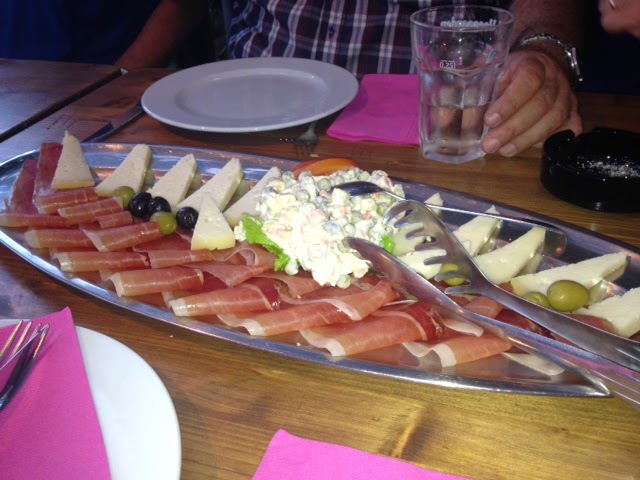
Our hosts have been treating us to wonderful meals with a lot of grilled meat, all kinds.
The fruits and vegetables are what you would expect to see in a mediterranean salad; cucumbers, tomatoes and olives.


prosciutto and goat cheese